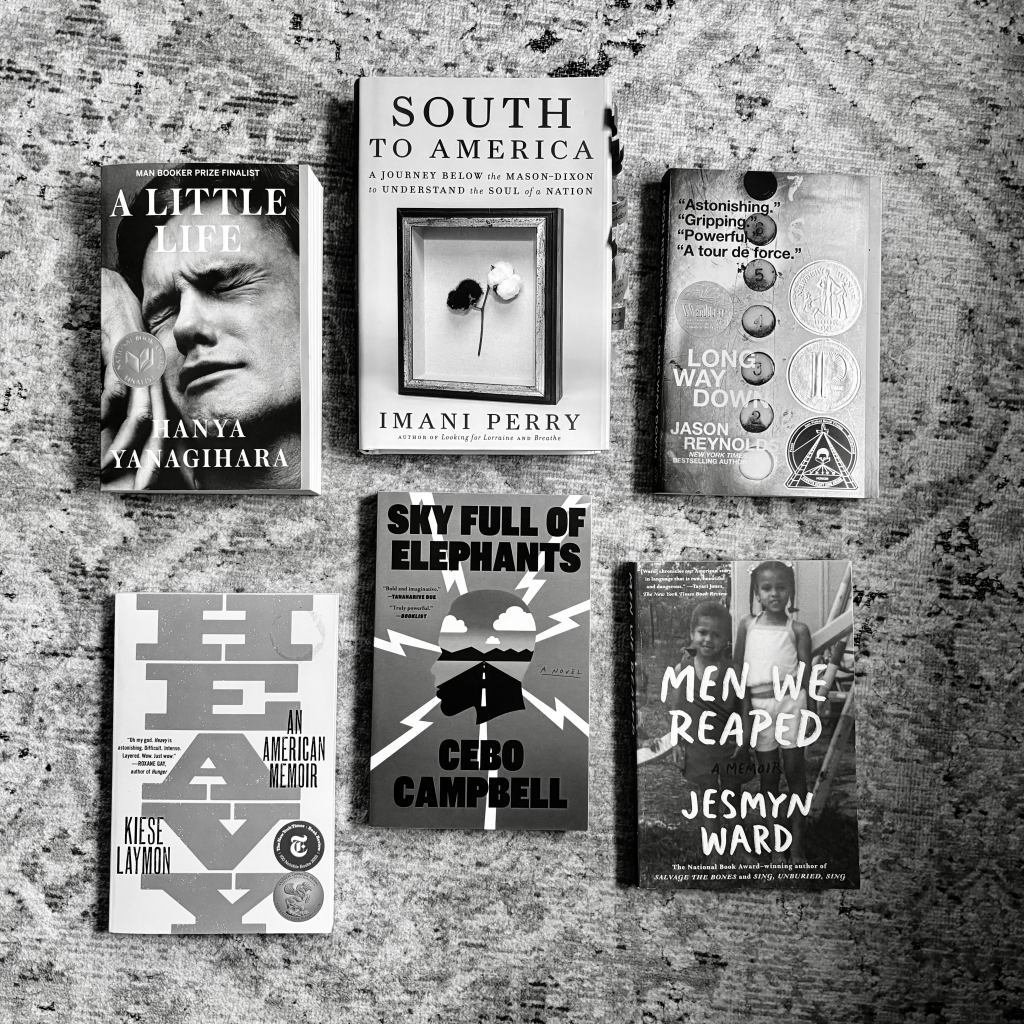
If my life needed to be represented with a single object, it would be a book. The legacy I will leave behind is love of the written word. Books were my safe place as a kid and remain the place I go when the real world starts to get a little too fictionlike. My children love books. They are tossed upon nearly every horizontal surface in our house. They are the “stuffy” they take on overnights to their grandmothers’ and the way they end their days to ensure a secure closure. Books have so much power in our world. I navigate what I read not only by my mood but by what I feel has not naturally occurred yet is essential to living a compassionate and genuine life.
While working at a local city library, I noticed the lack of diversity in the book world. I was aware of it before, but being on the inside made it seem even that more important. In a place where people go to seek guidance in what to read, the writers being presented were nearly all the same. Well, unless it was February. Then maybe there was a table or a special social media announcement. I was hired in July. At the first staff meeting I attended, our boss said that it was important that we stayed on top of all holidays, pointing out that they had not had a table for Juneteenth. I was one of maybe three people of color working on the staff of over 30. It was the responsibility of myself and about 12 others to create displays for the library. I discovered early on the limitations to creating an impactful display containing diverse writing. For example, when searching for Black writers, you would be met with the same writers in perpetuity: Toni Morrison, Richard Wright, Maya Angelou, James Baldwin, etc. These are great writers. Essential reading. They are considered contemporary authors, even. Many consider “contemporary” to mean post World War II. We are coming up on nearly 100 years postwar and a whole lot has happened in that time. Readers are missing out on entire generations of writers that have incredible ways of interpreting their experiences. Library workers, booksellers, and others in the book industry need to have a diverse reading habit themselves in order to actually recommend diversely. What I often encountered were those in the industry reading what publishers were pushing so they could best accommodate the public. When I asked a librarian colleague about the lack of movement on the displays with writers of color, she noted she had the same observation and was unsure how to engage the community to read more diversely.
It is September 2025. I google “black writers” on my personal computer containing an algorithm thick with Black literature. The first seven are no longer living. They include some of the aforementioned writers as well as Frederick Douglas (1818-1895), Zora Neale Hurston (1891-1960), Octavia Butler (1947- 2006), and Langston Hughes (1901-1967). The first website is PBS, listing “13 Black Authors to Read.” None of the 13 are still living. Yes – read these writers! They paved the way for Black writers today. But WHO are the Black writers of today?
When you walk into the bookstore, check out your suggested reads on Goodreads, or browse book recommendations online on most any platform, I challenge you to see what the writers have in common. You will most likely find that they are mostly female. And mostly white. This makes sense considering that the publishing industry (agents, marketers, editors, etc) is nearly 75% straight, white, women. This is according to the 2023 Diversity Baseline Survey conducted by Lee and Low Books in New York City. Can people recommend and market books that aren’t for those who look and experience life like them ? Absolutely. Do they? Not very often.
When I discovered that I could easily read 100 books a year, I looked back at my reading history. I looked way, way back. As a child, I can’t remember reading any books by a person of color. It was all A Little Princess and The Secret Garden. I was also very much invested in Zlata’s Diary by Zlata Filipović. It’s a diary of the Bosnian war from the perspective of a 10 year old girl trying to escape with her family. As I was coming of age, my favorite author was Wally Lamb. Yes, I relied on a white man to create a piece of art that I could connect to as a biracial girl growing up in the hood. I did. She’s Comes Undone was a cherished journey for me but I did not know that there were people like me writing books. I also didn’t see people who looked like me or lived like me on television or in movies so I didn’t know to question. My parents were busy working opposite shifts to ensure we were able to have what we needed. I never saw them with books. They accepted this was the media that was available. I accepted that my experience was not one that was valued enough to be represented on a mass level.
Like many, it wasn’t until the Black Lives Matter movement took off that I started to believe that my experiences, and those like it, truly mattered. Black artists of all kinds started gaining recognition from those with the power to influence. I started to shed some of that fear that if I leaned into Black stories, I wouldn’t become a target to eliminate – in all senses of the word. I found Kiese Laymon. His conversationalist, poetic, intellectual writing style blew up my literary world. I didn’t know you were allowed to write by your own rules. Kiese is a Black man from Mississippi about a decade my senior but I didn’t know the real experience of being “seen” in a book until I read Heavy. My father’s parents are from the South. I spent many of my childhood summers in the boot of Missouri (pronounced “Ma-zur-rah) chasing feral cats and “Gettin Mo’ at the Sto’. He was able to embody many of the family members I had not seen in a book before. He also opened a window to a world I thought was completely closed off to me: that of the Modern American Black man. I have many Black men in my family but transparent vulnerability takes bravery that does not come cheap. It allowed me to feel compassion in a completely different way for those in a life I would never have to experience but experience life alongside.
Celebration of the Black Experience has deflated since 2020. I won’t delve into the politics behind why but know that it means you have to do more work to find artists left behind. Following are some great resources to discover stories you may not have found otherwise:
I sat down to write about Black writers but this message impacts more than them. Read about everyone – not just who you want to be or who you believe can validate your own existence. When we see the connection in all of us – Black, brown, white, yellow, disabled, queer, neurodivergent,typical, young, old, neurotic, academic, undereducated, rich, poor, and all the things in between – that is when we are able to find a euphoria worth fighting for. Each other. Joy is found in each other.
When curating your reading lists this year, I challenge you to seek sources outside of your algorithm and your inner sphere. And do so with an open heart.
Some of my favorite books written in the last 20 years by writers of color:
South To America by Imani Perry
The Weight of Blood by Tiffany D Jackson
Ordinary Girls by Jaquira Diaz
Long Live The Tribe of Fatherless Girls by T Kira Madden
Boy, Snow, Bird by Helen Oyeyemi
Sky Full of Elephants by Cebo Campbell
A Little Life by Hanya Yanagihara
Long Way Down by Jason Reynolds (Also treat yourself to Ain’t Burned All The Bright)
You can follow my current reads at The StoryGraph username: bytifcohen.
 tifcohenwrites.com